In 2025, Amazon announced that more than 1.6 billion items were delivered to UK customers on the same or next day of making a purchase.
If you manage your own-fleet deliveries, that number in particular matters, because Amazon’s delivery experience has become the baseline delivery experience customers expect week in, week out, irrespective of who they are ordering from.
This concept is widely referred to as the ‘Amazon effect’: the phenomenon that describes how the delivery standards of the retail giant have permanently reshaped baseline expectations across retail and beyond into business-to-business.
In this post, we explore what the Amazon effect means for modern fulfillment, the level of delivery experience UK shoppers now demand as standard, why these pressures extend beyond B2C retail, and where own-fleet operators should focus their resources to meet those expectations without reaching breaking point.
What is the ‘Amazon effect’?
The Amazon effect is the influence Amazon’s fast, free, and trackable delivery has had on customer expectations across every sector. Customers now judge any delivery, whether a parcel or a pallet, against Amazon’s exemplary delivery experience, irrespective of whether it’s from a first time e-commerce website running a two-person delivery operation or international conglomerate.
The term ‘Amazon effect’ comes from Daugherty et al. (2019) and it is first referenced in their 2023 study in the Journal of Consumer Behaviour, which assesses consumer views online surrounding modern-day delivery practices and the phenomenon’s attribution to ‘customer impatience’.
Professor Jason Miller makes a similar point, describing how a generation (Gen Z) raised on same or next-day delivery now treats it as the new ‘normal’ or standard – alluding to how Amazon has fundamentally reshaped consumer expectations around delivery speed and convenience.
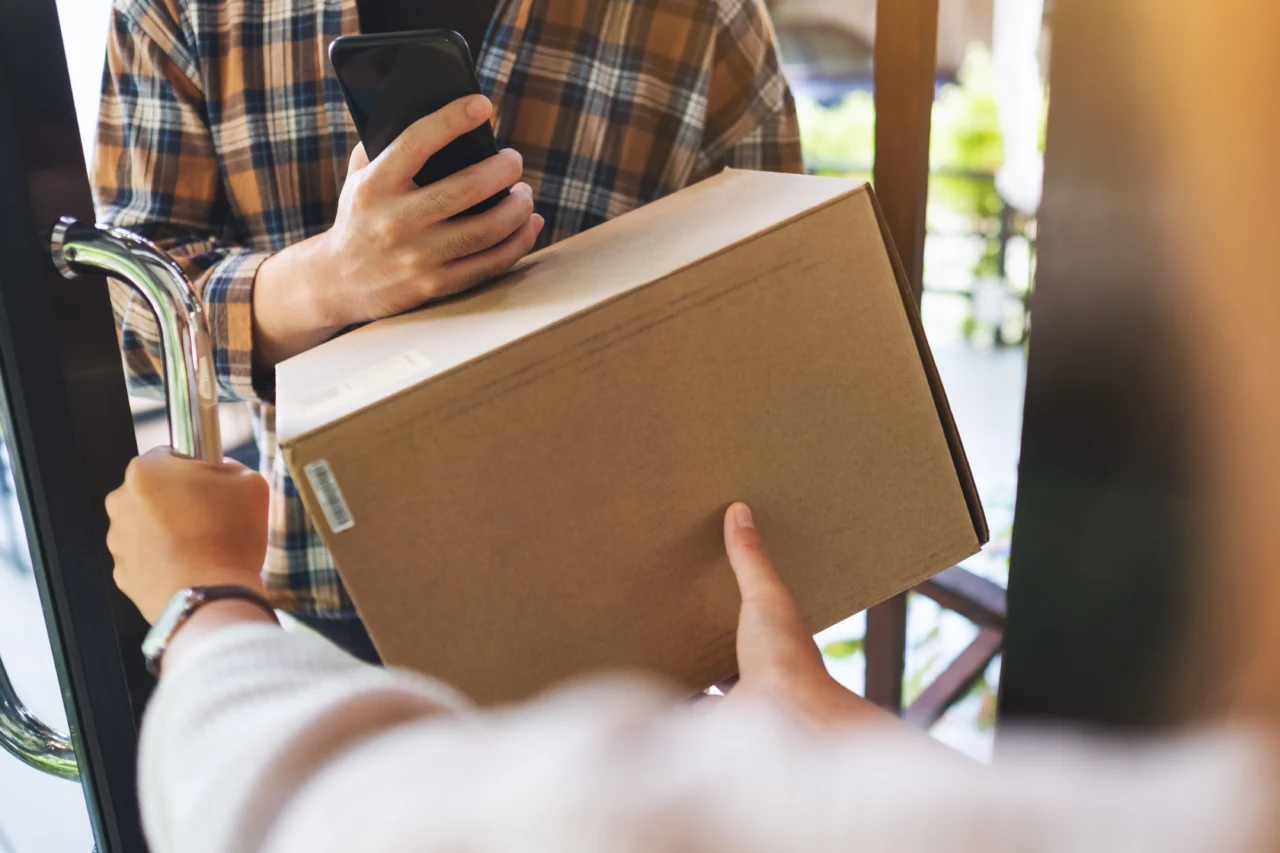
How Amazon changed delivery expectations
Amazon didn’t change expectations overnight. The psychological changes have taken decades to become standard practice.
However, the launch of ‘Amazon Prime’ can be seen as a key turning point:
- 2007: Prime launches in the UK with One-Day Delivery.
- 2025: More than 1.6 billion items arrive the same day or the next day in the UK, and Same-Day Delivery covers over a million items in more than 80 UK towns and cities, according to Amazon.
- January 2026: Amazon Now brings 30-minute grocery delivery to select Manchester postcodes, its first expansion beyond London.
- 2026: Fresh groceries are added to same-day delivery in London, and Amazon Now is due to reach Birmingham.
Amazon’s own executives have been forthright about how the multinational conglomerate deliberately engineered this shift in consumer behaviour.
Doug Herrington, CEO of Worldwide Amazon Stores, noted that ‘Fast, free delivery with Prime changed customers’ expectations’, explicitly acknowledging that rapid fulfillment and delivery has become a catalyst that permanently altered what contemporary shoppers consider ‘standard’.
While in the UK, Country Manager John Boumphrey stated, ‘Fast, reliable delivery makes a real difference to our customers’ everyday lives’, framing speed and dependability as essential conveniences rather than occasional perks.
What UK customers expect from deliveries now
Recent data underscores just how deeply these expectations have become the norm for UK consumers.
A November 2025 survey of more than 8,000 consumers found that most UK shoppers expect free two-day delivery as standard, while viewing £5 to £8 as a fair surcharge for next-day or same-day fulfilment on a typical £30 to £50 order.
As the study’s summary concludes, ‘delivery performance has shifted from a differentiator to a baseline expectation’ – meaning that getting an order to a customer’s doorstep on time no longer sets an operation apart, whereas getting it wrong actively sets it back.
And these expectations are further compounded by price sensitivity and conditioning from retail giants.
A 2024 report found that 65% of UK consumers are less likely to shop with a brand because of high shipping costs. And customers are used to the marketplace experience: 74.6% of British consumers shopped on large online marketplaces in 2024.
Beyond speed and price, modern customers want to see where their order is through comprehensive delivery tracking, choose how it arrives along with photographic evidence, and expect to hear from retailers in the form of delivery notifications before something goes wrong.
You may be forgiven for thinking that this ‘fast delivery expectation’ is confined to smaller items, but research from Linnworks about the “State of Home & Garden ecommerce” shows that 41% of the 4,000 US and UK online shoppers surveyed expect fast delivery.
That’s a significant operational challenge when delivering big & bulky items.
The cost of getting delivery wrong
Since customers have become accustomed to seamless fulfilment and delivery, they will move to a different brand or retailer if their first delivery experience doesn’t meet their expectations.
Research has found that 60.1% of UK consumers would switch brands for more convenient delivery, while 56.4% would actively look for alternatives after a single disappointing experience.
The reputational fallout extends well beyond the individual shopper, too.
A study found that 70% of UK consumers were less likely to shop with a retailer after hearing about a negative delivery experience, and over 60% had shared one themselves, turning isolated logistics failures into a potential customer acquisition challenge.
The Amazon effect isn’t just a B2C problem
Crucially, this shift isn’t confined to just consumer retail: trade and business buyers are a different type of consumer, but they bring the same expectations.
Research from L.E.K. Consulting highlights that digital delivery orders now account for 30% of planned orders for builders’ merchants, putting pressure on them to offer the kind of reliable delivery windows popularised by marketplaces like Amazon.
The friction lies in the fact that B2B and specialist fulfilment is vastly more complex than dropping a standard parcel on a doorstep.
Delivering plasterboard to an active construction site, coordinating a two-person white-glove furniture installation, hitting strict temperature and time-sensitive windows for food and drink distribution, or managing multi-drop wholesale routes all demand careful planning around vehicle restrictions, tight site schedules, and specialised unloading requirements.
Amazon’s standard parcel network was never intended to offer this level of operational complexity, as it prioritises speed and convenience over bespoke services, yet the end customer still expects accurate, real-time visibility into when their order will arrive, regardless of the logistical challenges behind the scenes.
How own-fleet operators can respond
- Build delivery windows you can keep. Accurate windows start with realistic routes that account for traffic, stop duration and vehicle capacity. Our guide to what route planning is covers the basics, and our Complete Guide to Delivery Route Planning goes more in-depth on the subject.
- Tell customers before they have to ask. Automated delivery notifications keep customers informed about their delivery window and any changes.
- Let customers see the delivery. Live delivery tracking gives customers and your office the same view of where a vehicle is.
- Prove it was delivered. Proof of delivery removes disputes and paper chasing. Our posts on why drivers need an ePOD app and paper vs digital run sheets contextualise and explain the benefits in depth.
- Measure what customers feel. Track on-time delivery, failed deliveries, and the number of “where’s my order?” calls. Peak periods expose weak spots first, so see our Peak Season Guide to Own-Fleet Logistics.
- Invest. Look for all-encompassing solutions, such as a Transport Management System, like Stream, which offers all of these mentioned features to help you deliver the Amazon effect by boosting efficiency, visibility, and reliability throughout the supply chain and last-mile.
Conclusion
The Amazon effect has turned fast, reliable, trackable delivery into a key differentiator and expectation for consumers after experiencing an exemplary delivery experience from the behemoth retailer.
For the majority of businesses, it is going to be near impossible to replicate Amazon’s logistical scale and resources, but businesses can replicate the experience it has taught customers to expect: an accurate delivery window, updates before they have to ask, and irrefutable proof the job is done through electronic Proof of Delivery (ePOD), while research suggests getting these core logistics aspects right helps build customer loyalty and boost revenue.
Frequently Asked Questions about the ‘Amazon Effect’
Amazon has made fast, free and trackable delivery feel normal. Prime launched in the UK in 2007 with One-Day Delivery, and Same-Day Delivery now covers over a million items in more than 80 UK towns and cities. Most UK shoppers now expect two-day delivery as standard, without paying extra.
Most expect two-day delivery as standard, and see £5 to £8 as the right price for anything faster on a £30 to £50 order. Beyond speed and price, they want to see where their order is, choose how it arrives and hear from you before something goes wrong.
Customers move. Research has found that 60.1% of UK consumers would switch brands for more convenient delivery, and 56.4% would consider alternatives if they were disappointed. Bad experiences travel too: 70% of UK consumers were less likely to shop with a retailer after hearing about a negative delivery experience.
Yes. Trade buyers are consumers too, and they have the same expectations. L.E.K. Consulting’s research found that digital delivery orders make up 30% of planned orders for builders’ merchants. B2B and own-fleet deliveries are also more complex than a parcel, with vehicle limits, tight schedules and unloading needs.
You don’t need to match Amazon’s speed. You need to match its certainty. Build delivery windows you can keep with route planning, send delivery notifications, offer live tracking and capture proof of delivery. Then measure on-time delivery, failed deliveries and “where’s my order?” calls.