
The festive period is usually a time for relaxation and celebration: spending time with the family, indulging in mince pies and mulled wine, but for unprepared retailers and logistics providers, business can quickly feel as though the Grinch has stolen Christmas.
There’s a reason it’s called peak season. It isn’t defined by a single day, but a sustained period of operational pressure that builds throughout October, November, and December, driven by Black Friday, Cyber Monday, Christmas, and Boxing Day – the biggest retail days of the year.
And the pressure doesn’t end there, though purchase demand may tail off in January (depending on consumers’ appetite for the inevitable January sales) the operational focus shifts to returns and exchanges.
Linnworks’ research shows Q4 accounts for nearly a third of annual orders and 30.9% of annual order value (£2.73bn / $3.68bn), yet despite this, many sellers still go into this period underprepared. Sellers unfortunately repeat last year’s mistakes and end up with cancelled orders, missed deliveries, frustrated customers, and negative reviews.
Our peak season guide draws on data and experience from ourselves and our partners Linnworks, Brightpearl, & Mintsoft to highlight and contextualise the key peak season challenges.
Those challenges commonly cause chaos for businesses and retailers that deliver their goods in their own vehicles. Our guide offers practical advice on how to prepare to help turn operational chaos into operational success.
Is your business ready to cope with a volume surge?
Retail and ecommerce see the biggest volume spikes during peak season as consumers indulge in festive splurges for their loved ones (or for themselves), with consumer electronics, apparel, jewellery, furniture, and specialty gifts being the core categories seeing significant increases in sales and revenue.
Brightpearl’s data agrees, too: about 30% of annual sales fall between Black Friday and Christmas, making peak the biggest stress test of a business’ back office systems all year.

But for businesses and 3PLs that deliver goods in their own vehicles, Mintsoft’s data suggests that Black Friday surprisingly wasn’t the busiest day for dispatches:
“When we look at the Black Friday week itself, the data challenges the assumption that Black Friday is the peak. Black Friday (28 Nov 2025) was the biggest day for orders placed, with 87,131 received, but Cyber Monday (1 Dec 2025) was the biggest day for dispatches, with 94,393 orders shipped, +43.9% more than Black Friday. The weekend in between tells its own story: Saturday and Sunday saw dispatch rates of just 44.3% and 42.2% respectively, meaning more than half of weekend orders weren’t fulfilled on the day they were placed.” – Mintsoft
It suggests that demand and fulfilment peak on different days, and the real operational crunch lags behind the order spike, taking a few days to ultimately play catch up after being overwhelmed.
This is particularly relevant for furniture items where lead times can be extended significantly. We’ve all bought a sofa or three-piece suite that can take up to 12 weeks to deliver as the item needs to be manufactured before being shipped.
It’s also worth noting that furniture is, but its very nature, “big and bulky” and requires specialist handling and delivery requirements. Many of Stream’s furniture retailers, manufacturers and distributors also offer added value services such as room of choice and assembly which can increase the time constraints on a delivery run.
The impact for businesses that are not prepared for peak season
Most retailers struggle to cope with this influx, too. CEVA Logistics reports that 91% of retailers have seen revenue losses linked to supply chain issues during peak periods.
Mintsoft’s weekend dispatch gap points to the same problem: orders arrive faster than businesses can physically fulfil, dispatch and deliver them.
These losses come from rising consumer demand meeting unreliable and capacity-constrained operational execution. Stockouts, last-mile delivery issues, poor internal data visibility, and warehouse labour shortages all compound, chipping away at precious margins.
And the damage is multifaceted; it extends beyond the sale. Mintsoft cites that 85% of shoppers are not willing to buy from a brand again after a poor delivery experience, so the impact on revenue losses can be both immediate and lasting, with the opportunity to create brand loyalty and return custom being lost at the point of a bad delivery day too.
Brightpearl highlights that customers expect fast delivery, status updates, easy returns and good support.
When those slip, negative reviews follow.
They estimate that businesses rated three stars earn up to 33% less revenue than five-star businesses and that negative reviews cost around $10,000 a year on average in handling costs.
In sum, it can quickly become a costly period for many reasons, giving credence to the old adage ‘by failing to prepare, you are preparing to fail.’
How to peak-season-proof your order-to-delivery processes
Peak season doesn’t have to be all stress and no reward.
October preparation largely determines what happens during the biggest retail days in late November and through December. Businesses that capitalise are the ones that treat the weeks beforehand as the real ‘peak’. This is where businesses build the foundations for success before peak season and beyond.
With this in mind, here are six key suggestions for making sure you’re ahead of the curve this peak season and beyond.
1. Lock in your tech stack before the rush
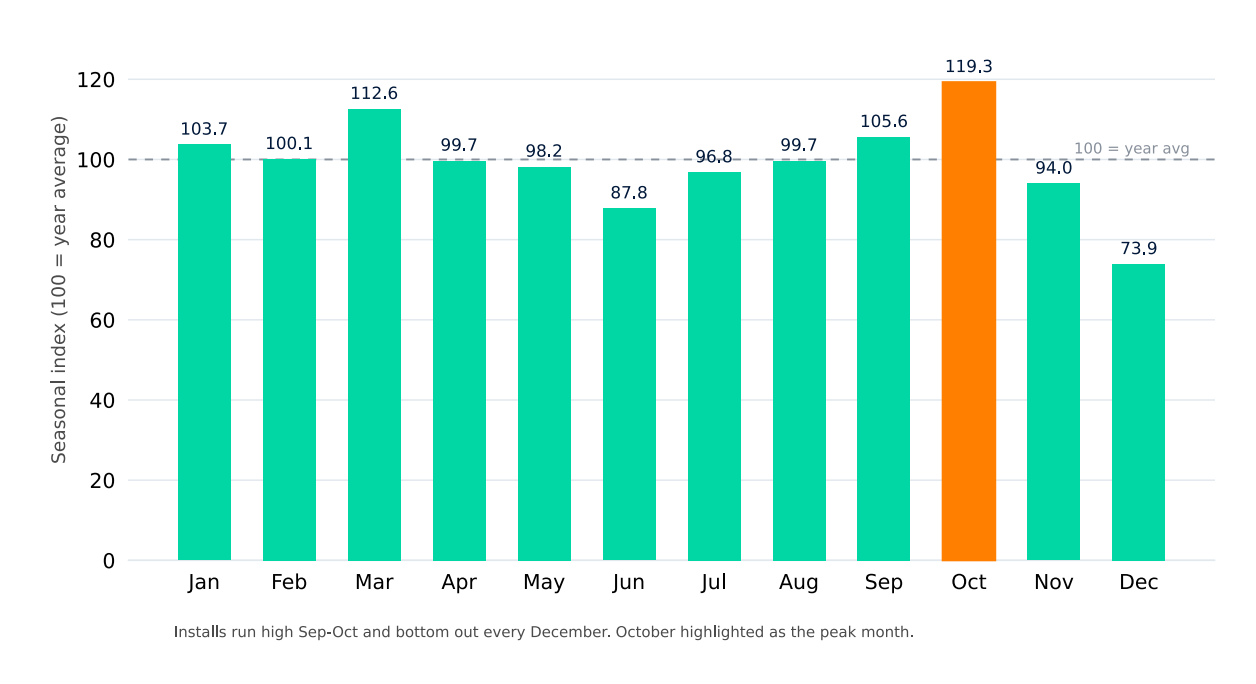
Encouragingly, Linnworks’ data shows that most sellers implement their selling tools ahead of the peak season rush, not during it. Marketplace and integration app installs peak in October, nearly a fifth above the monthly average, then continue to fall away throughout the rest of the period. By November, most operations have stopped changing and tweaking things and are running on a settled tech stack. It’s highly recommended that businesses leave at least 40 days for any operational change to go live and settle before that October prep window opens. That puts the ideal start for a system change or implementation in late August, so with Black Friday on 27 November, that puts your cut-off at roughly 18th October, give or take.
And if you haven’t decided on your tech stack yet, there are options available when looking at an efficient order-to-delivery ecosystem, and you still have a clear route to implementation. It’s recommended to choose tools that can be implemented and ‘go live’ quickly without disrupting what already works. More orders at peak means more deliveries, and delivery is often where it’s make or break for a brand, since it’s usually the only physical touchpoint with the customer.
If you do deliver goods in your own vehicles, Stream’s Transport Management System is built for the last mile, from order to doorstep, with features designed to tackle the key bottlenecks associated with deliveries. It connects to the tools and marketplaces you already use or sell on, with ready-made integrations for Linnworks, Brightpearl, Mintsoft, Shopify, Sage 200, SAP Business One, and Unleashed, plus open APIs and webhooks for anything bespoke.
That means you can connect your back office, marketplaces or online store, and your delivery logistics in one synchronised workflow: orders come in, routes are planned, deliveries are made and tracking is sent back to the marketplace automatically, with minimal manual input.
2. Automate everything between the warehouse door and the van
Brightpearl’s assertion that ‘manual post-purchase work is slow and error-prone’ is correct, and Mintsoft’s weekend dispatch gap shows what happens when processes can’t keep up with demand. Most systems automate as far as the warehouse door. After that, the work is often still manual and completely inefficient: routes are planned on inefficient spreadsheets, drops are sequenced by hand, paper Proof of Delivery forms are used, and it doesn’t have to be that way.
Stream picks up where those systems stop. Orders flow in automatically from the back office platforms and marketplaces we’ve mentioned, and one-click auto-planning builds those orders into efficient routes and makes the most of each vehicle’s capacity so that no space goes to waste. During loading, barcode scanning checks that the right orders are on the right vehicle in the right sequence.
The result is fewer manual steps, fewer driver mistakes and less time spent planning, so more orders can go out the door without more people to handle them.
3. Treat every channel the same, and protect your seller account
Linnworks’ data shows every channel peaks in the same Q4 window, so the more channels you sell on, the more sets of expectations and consumers you have to meet at once. Connecting them all to one ecosystem gives you a single view of what’s due out.
If you fulfil marketplace orders yourself, your delivery visibility should be a priority. Stream automatically passes valid tracking IDs back to Amazon, eBay, Temu, Argos, B&Q, and more.
Accurate tracking and timely proof of delivery help head off “Item Not Received” claims, which protects your seller metrics just as disputes would otherwise start to climb.
As Home Furnishings says, Stream has enabled them to remove fraudulent A-Z and INR claims and achieve a 95%+ VTR with Amazon for their in-house logistics operation:
“What it’s provided is irrefutable proof to the marketplaces. When we deliver something sold on Amazon or on eBay and the buyer makes a fraudulent claim, every single tracking event is available. It’s literally there in black and white. There’s not even a 1% chance of the buyer winning that fraudulent claim.”
4. Keep customers informed from order-to-delivery with tracking and notifications
With 85% of shoppers reportedly not buying again after a poor delivery, the doorstep is where customer trust can be won or lost. Brightpearl’s list of what customers expect (fast delivery, status updates, easy returns, good support) is a useful test of where yours might slip.
Automated email and SMS updates, live tracking, accurate ETAs and precise drop locations with what3words customers informed and engaged without picking up the phone. At the door, electronic proof of delivery captures a signature, photo and GPS location instantly, so “where is my order?” enquiries are kept to a minimum – freeing your staff’s administrative hours for other tasks. Delivering with your own fleet also lets you offer premium services such as white-glove assembly, which traditional 3PLs struggle to provide.
5. Take control of delivery capacity and cost
Mintsoft notes that carriers fill up and add peak surcharges between Black Friday and Christmas. An in-house fleet gives you capacity that isn’t subject to those bottlenecks, as long as the correct systems are in place and there’s a clear plan. Multi-drop and multi-depot planning through platforms such as Stream cuts wasted mileage. HGV navigation, digital walkaround checks and defect reporting keep vehicles compliant and drivers safe while completing more drops per day, so you have complete control over your fleet and the delivery experience you offer, while doing so in a cost-effective and safe manner.
It’s not just capacity and cost that come under strain: CEVA Logistics reports that parcel losses and damages across Europe rose by up to 40% over Black Friday weekend, as surging small-parcel volumes put last-mile networks under pressure.
Delivering goods in your own vehicle(s) puts you in control of how every order is handled, loaded, and delivered, particularly as you can capture clear evidence of what was delivered, where, and in what condition, rather than relying on a possibly strained and inefficient outsourced network.
6. Manage by exception, then learn from it
During peak season, few operations have the capacity to watch thousands of orders at once, and they shouldn’t have to. As Brightpearl highlights:
“It’s essential to have a complete picture of how well things are going — and to be able to instantly access the information you need to maximize sales during peak season, you won’t have time to go hunting for it.”
There’s no time to go hunting for information once demand hits, so you need logistics monitoring that shows every delivery live and flags only the ones running behind schedule. Mintsoft’s weekend dispatch gap shows how quickly a backlog can build unseen, and live monitoring means your team steps in as issues happen, not on Monday morning or after customers complain. Operations, customer service and management all work from the same real-time view, so you can manage by exception.
Once the peak season dust settles, Stream’s full audit trail for every order turns failed, replanned and late deliveries into data. Next year’s peak plan then starts from what actually happened, not from memory, with the bottlenecks clearly identified and ready to be addressed.
Conclusion: your peak season checklist
Peak season rewards the businesses that prepare early and punishes those that leave it to chance. For businesses delivering in their own vehicles, that means getting the last mile as ready as the warehouse. Before the rush arrives, check you can tick off all six:
☐ Lock in your tech stack. Your order-to-delivery systems are decided on, connected, and live early enough to settle before the peak chaos hits.
☐ Automate between the warehouse door and the van. Orders flow in automatically, routes are auto-planned, and loading is barcode-checked, so volume doesn’t mean more headcount.
☐ Treat every channel the same, and protect your seller account. Every marketplace and online storefront is covered, with valid tracking and proof of delivery passed back automatically to these platforms.
☐ Keep customers informed from order to delivery. Live tracking, notifications, accurate ETAs and electronic proof of delivery answer “where is my order?” before it’s asked.
☐ Take control of delivery capacity and cost. Your fleet is planned to cut wasted mileage, with compliant vehicles and your own capacity outside carrier bottlenecks.
☐ Manage by exception, then learn from it. You can see what’s running late as it happens and easily review what actually happened once peak season is over with a data-driven approach.
Tick all six, and you’re set to turn peak season from a stress test into your most successful stretch of the year.
Missing a few? The good news is that each one is fixable, and the businesses that act now have the path to a successful peak season. With Black Friday on 27 November, the time to start is now, in early October.