Are you still using paper-based Proof of Delivery for your logistics operation?
If so, you’re opening yourself up to a significant liability risk.
You’re also creating a significant blind spot in your operation that is costing you and your business time, money, and customer trust.
An electronic Proof of Delivery (ePOD) app is nothing new, and is no longer a ‘luxury’ that’s exclusively available to large, enterprise businesses.
It should, in fact, be considered a requirement for any business delivering goods and products using its own fleet.
ePOD apps are accessible to fleets of all sizes, whether it’s a single-vehicle operation, or an enterprise business with hundreds (if not thousands) of vans, trucks, and HGVs.
So let’s dig into exactly why your delivery drivers need an ePOD app, and why the switch to digital proof of delivery will benefit your back office teams.
1. Stop guessing where your goods are
When a driver leaves the warehouse with a stack of paper, they are effectively entering a black hole.
You don’t know if a delivery has been successful until they return to the depot at the end of their shift, assuming every paper POD finds its way back to depot, which can cause a whole host of issues.
By the time a driver finishes capturing proof of delivery in the app, the system can have automatically updated the delivery status and notified the customer.
With an ePOD app, delivery statuses and events update in real-time.
Every barcode scan, every GPS location, every signature, note, and photo.
The moment a driver completes the required proof of delivery, the ePOD system reflects it.
You effectively get a live feed of progress across your entire fleet, allowing you to manage exceptions as they happen, rather than wasting valuable time on doing damage control the following morning.
2. Irrefutable delivery evidence
‘I never received it’ is a phrase that significantly impacts profit margins.
Without photographic evidence and a precise GPS location stamp, it is essentially your word against the customer’s.
ePOD apps allow drivers to:
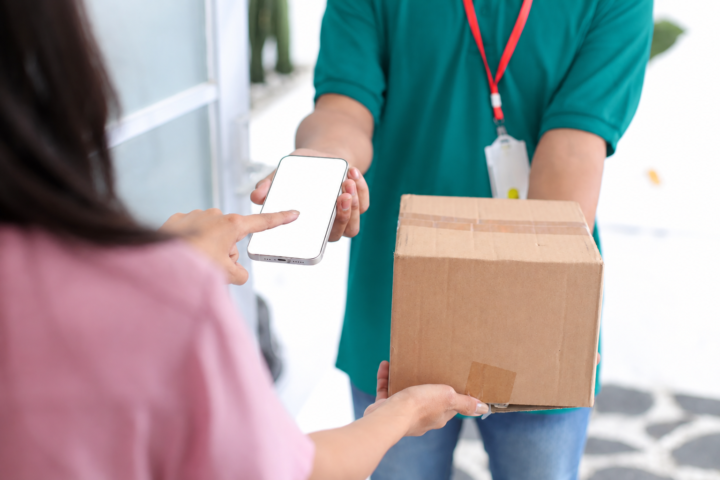
- Capture sign-on-glass signatures: digital signatures that prove a person received their order.
- Take photo verification: Crucial for “safe place” deliveries or documenting the condition of goods upon arrival.
- GPS & time-stamping: Every event is anchored to a specific coordinate and an exact second, creating an audit trail that is impossible to argue with.
3. Protect marketplace ratings and reduce claims
Selling on marketplaces, such as Amazon and eBay, brings incredible volume, but it also introduces the risk of ‘Item Not Received’ (INR) disputes.
Marketplace algorithms and customer service teams generally favour the buyer, unless you can provide airtight, digital proof of delivery and valid tracking.
If you manage your own in-house logistics for Amazon and eBay orders, maintaining your On-Time Delivery Rate (OTDR) and Valid Tracking Rate (VTR) is non-negotiable.
Using an integrated ePOD solution, which is listed as an approved carrier on these marketplaces, ensures that every order is backed by valid tracking and clear, auditable evidence,to ensure funds are not withheld from your accounts.
4. Dynamic handling of on-site delivery events
Deliveries rarely go perfectly.
Maybe the customer only wants half the order, or a specific item is damaged.
Using paper, these changes require messy scribbles that the accounts department has to decipher later.
An ePOD app allows drivers to adjust quantities and split line items on the spot. If an item is rejected, the driver can record the specific reason and attach a photo of the damage.
This data flows back to your ERP or accounting software instantly, ensuring the invoice is accurate the first time.
5. Answer the question:”Where Is My Order?” (WISMO)
Customer service teams spend hours answering phone calls from people asking for updates and the age old ‘where is my order?’ enquiry.
By the time a driver finishes capturing proof of delivery in the app, the system can have automatically updated the delivery status and notified the customer.
Providing this transparency reduces the volume of inbound enquiries.
Customers can then get the confirmation they want via email or SMS, and your team stays focused on high-value tasks instead of tracking down drivers for updates.
Should you switch to an ePOD app?
In an era of rising fuel costs and heightened customer expectations, efficiency is the only way to stay competitive.
Moving to an ePOD app removes the friction of manual data entry and provides the ‘track and trace’ visibility that modern commerce demands.
It protects your business from claims and gives your drivers the tools they need to work faster and more accurately.
However, these are only a handful of reasons your delivery drivers need an ePOD app.
If you’d like to learn more about all of the features available in an ePOD app, visit: Capture instant proof of delivery
Delivery driver ePOD app FAQs
ePOD stands for Electronic Proof of Delivery. Instead of using paper forms, drivers use an app on a smartphone or rugged device to record delivery data. The system captures digital signatures, photos, and GPS locations, then syncs that information instantly with the back office.
Yes. Top-tier ePOD apps include offline functionality. Drivers can continue to scan items, take photos, and collect signatures in remote areas or ‘dead zones.’ The app stores the data locally and automatically uploads it to the main system once a data connection is restored.
The app creates an irrefutable audit trail. By capturing a ‘sign-on-glass’ signature alongside a GPS-stamped photo of the delivery, you have clear evidence of exactly when and where the goods were left. This prevents “item not received” claims and protects your margins.
Absolutely. Rather than crossing things out on a paper manifest, drivers can adjust quantities or split line items directly on their screen. They can also record specific reason codes for rejections and attach photos of damaged goods, ensuring the final invoice is accurate.
Many ePOD platforms include integrated walkaround checks. This allows drivers to complete their legally required daily vehicle inspections within the same app. Any defects are reported digitally in real-time, allowing fleet managers to schedule repairs before they cause a breakdown.
It significantly reduces ‘Where Is My Order?’ (WISMO) calls. Because the system updates in real-time, customers can receive automated SMS or email notifications the moment their delivery is complete, often including a link to a digital PDF of the proof of delivery.