

1. Introduction to electronic Proof of Delivery (ePOD)
Whenever your business delivers something to your customer, there are three key questions that you need to be able to answer.
Not being able to answer those fundamental questions can often lead to additional costs to the business, unhappy customers, and negative feedback.
The three questions you need to be able to answer are:
- Did the goods arrive at the correct place?
- What condition did they arrive in?
- Who signed for the delivery?
Proof of delivery is an essential tool in an efficient and effective logistics operation.
It provides you with clear evidence in answer to each of the questions above. Electronic Proof of Delivery (ePOD for short) is simply the digitisation of this common practice.
ePOD is often adopted due to the way in which it streamlines the proof of delivery capture process, boosting traceability with clear audit trails logged against each order, and mitigates the need for storing thousands of paper documents.
In this guide, we’ll cover exactly what electronic proof of delivery is, how it differs from traditional proof of delivery, what are the benefits, the different types of proof available to operators, how it works across different industries, as well as breaking down some of the common mistakes and what you can do to avoid them.
2. What is Electronic Proof of Delivery?
We often hear people asking ‘what is proof of delivery?’ ‘What constitutes proof of delivery?’, and ‘How does it differ from electronic Proof of Delivery?’
At its core, Proof of Delivery (POD) is a form of evidence, or receipt, which is used to confirm that goods have been delivered to the intended recipient.
Electronic Proof of Delivery, therefore, is a form of evidence or receipt, captured digitally, which confirms that goods have been delivered to their intended recipient. This is often achieved through the use of digital signature capture, photographic proof of delivery, GPS location and time/date stamps.
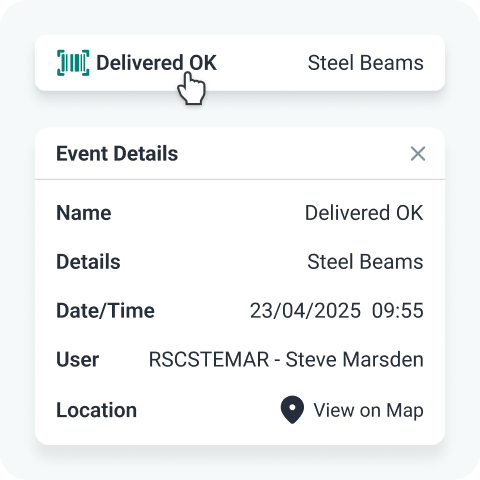
Compared to traditional proof of delivery, ePOD provides a complete picture of the delivery, detailing the: who, what, where and when for every order.
3. Why Businesses Use ePOD: Benefits & Impact
Whether you’re a new business that’s just starting out, or whether you’re considering a transition from traditional paper-based proof of delivery, electronic Proof of Delivery has a wealth of benefits just waiting for your logistics operation to take advantage of.
Streamline delivery driver workflows
Gone are the days of having to sift through piles of paperwork in the vehicle’s cab, searching for the relevant blank form to fill out on completion of each delivery.
Now, in the age of ePOD apps, a driver can simply tap on the relevant job on their mobile device, confirm the condition of the goods, capture photographic proof of the delivery being completed successfully, and request a digital signature from the customer as they receive it.
Not only that, but as soon as they take action the delivery in their ePOD app, it can be accurately time, date and GPS-stamped, to provide clear evidence of exactly where and when the delivery occurred.
Fewer disputes and customer complaints
We’ve all seen the posts on local social media groups, where a neighbour was out of the house when a delivery was made, and now they’re looking for help in locating the package.
If they’re unsuccessful in locating their delivery, you can almost guarantee that it will lead to multiple phone calls to your customer services and transport team and the wrath of negative feedback published online for the world to see.
That’s where the power of an ePOD system’s GPS stamping comes in.
Not only can customers be notified as soon as the delivery has been made, but they can also be given the precise coordinates of where the delivery was made, plus the names and signatures if it was signed for by a neighbour.
An ePOD app with time, date, GPS stamps and photo evidence can also aid you in disputes where porch piracy may be involved or where customers are making fraudulent claims about goods not being delivered.
Clear audit trails
The date, time and GPS stamping of every delivery provide you with a clear audit trail of when each action relating to the delivery occurred.
Not only that, but the vast majority of ePOD systems will also display the details of the specific driver and / or operator who performed each action, giving you a track and trace audit trail for all of the goods that you deliver.
Better back-office efficiency
With an ePOD system in place, you no longer need to wait for the driver to return from their run to understand what has happened with any of the deliveries that they’ve made.
Back-office teams can receive real-time updates on the status of every order and be working on resolutions to any issues before the driver returns to the depot.
And that’s ignoring the fact that an ePOD system eliminates the need for mountains of paperwork to be processed on their return, or that you’ll no longer need rows of ceiling-high storage cabinets in which to store historic POD documents!
Cost savings and environmental benefits
Cost saving is a key concern for any management team when looking at new systems to provide efficiency gains for the business, and with companies now having sustainability targets to meet, so too are the environmental benefits.
- Less paper, less waste – By replacing printed delivery notes, invoices, and signatures with digital records, ePOD cuts down on paper use, ink, and physical storage, thus reducing deforestation and landfill waste.
- Fewer failed deliveries – Real-time updates and accurate delivery data mean fewer missed deliveries and repeat journeys, which leads to lower fuel use and emissions.
- Optimised routes – ePOD systems often integrate with routing tools, helping drivers take the most efficient routes. Less time on the road = lower carbon output and lower fuel bills.
- Reduced admin and transport – No need to transport paperwork back to depots or store physical archives. Everything is captured and shared digitally, reducing unnecessary movement and storage.
- Faster issue resolution – With instant access to delivery data (signatures, photos, timestamps), disputes are resolved quickly, which reduces the need for additional trips or reshipments.
4. How Electronic Proof of Delivery Works
An ePOD system functions as a continuous data loop, ensuring that every participant in the supply chain, from the warehouse manager to the end customer, is operating on the same set of information.
Stage 1: Data preparation and job dispatch
The process begins in the back office, where the Transport Management System (TMS) aggregates order data, customer details, and specific delivery requirements.
Instead of printing these onto a paper manifest, the system will create a delivery run containing the jobs and push this data directly to the driver’s mobile app.
This ensures the driver has everything they need, including delivery routing information, special access codes, gate instructions, and precise item lists, before they even start their engine. The driver can then depart on their delivery run and head to the first stop, while customers can simultaneously be notified that their order is out for delivery.
You can further streamline the process of processing data by integrating your TMS with your other back office systems: warehouse, inventory, manufacturing, finance and stock management systems are common applications to connect to ensure your business operates efficiently right across the board.
Stage 2: Item validation via barcode scanning
Upon arrival at the delivery location, the driver uses the ePOD device to scan barcodes or QR codes on the physical delivery packages.
This step acts as a verification gate, where the software cross-references the scanned items against the digital manifest in real-time, which aids the driver in ensuring a complete delivery of all goods for that stop.
There are a number of considerations when it comes to ePOD devices for drivers.
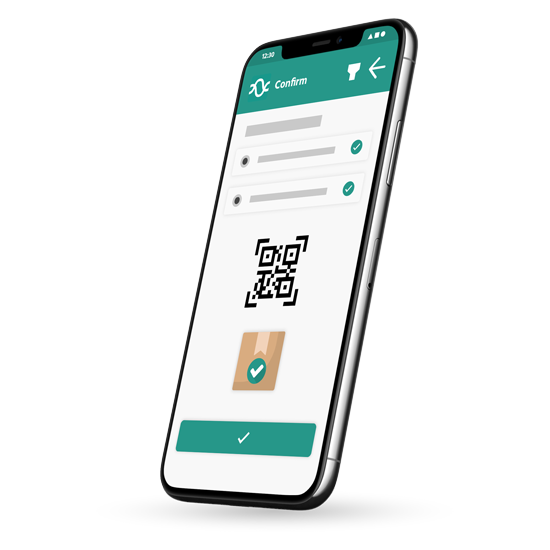
For example, rugged ePOD devices can offer better, faster barcode scanning in low-light situations, and are also built to sustain a great number of bumps and scrapes.
Stage 3: Capturing evidence and handling exceptions
Once the items are validated, the driver proceeds with the delivery to the customer.
This typically involves sign-on-glass signature capture and high-resolution photographic evidence of the goods at the delivery point.
If something goes wrong, such as a damaged box or a customer not being available to sign, the driver doesn’t just write a vague note.
They use the app to record specific details about the delivery event and take supporting photos.
These notes are then attached to the delivery record, with an automatic time, date and GPS stamp, to create an indisputable ‘where and when’ for the event.
The customer will then be able to view these in their proof of delivery and/or tracking information.
Stage 4: Real-time sync and automated confirmation
As soon as the driver hits ‘complete,’ the device syncs with the cloud.
The back office team can see the successful status immediately, allowing them to trigger the invoicing process without waiting for the vehicle to return.
Simultaneously, the system sends an automated confirmation to the customer via email or SMS.
This notification often includes the photo of the delivery and the exact time of arrival, closing the loop on the customer experience and providing instant peace of mind.
Alternatively, if there are any issues with the delivery, the back office team can be working on a resolution while the driver is on their way to their next stop.
5. Types of Proof of Delivery
An effective ePOD system captures multiple data points to create a comprehensive, indisputable digital record.
Signatures and ‘sign-on-glass’
Electronic signature capture remains central to the whole ePOD process, with ‘sign-on-glass’ technology allowing the recipient to sign directly onto the device screen. Robust ePOD applications must offer flexibility for security and compliance, including:
- Direct signature: Requiring the signature of the specified recipient.
- Indirect signature: Allowing a signature from a colleague or building manager.
- Adult signature: Necessary for regulated goods, requiring ID verification.
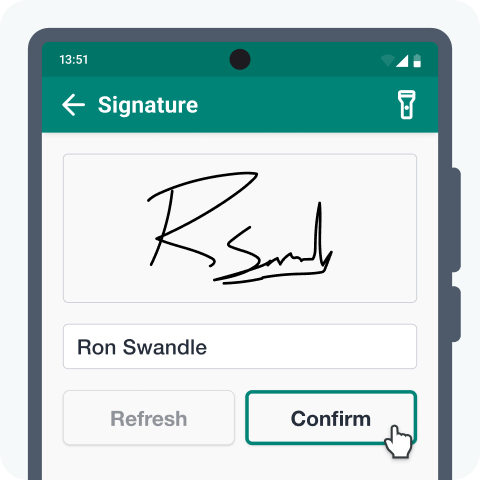
The driver must also have the ability to record detailed digital notes alongside the signature.
Photographic Proof of Delivery
Capturing photographs of a delivery enables evidence and visibility of things that a signature alone cannot.
There are a number of reasons to capture photos as proof of delivery, but the key roles of photo POD include:
- Condition of goods: Provide visual confirmation that items were delivered intact or document any damages.
- Location verification: Capture the delivery location (e.g. front door or safe place) to confirm the driver was at the correct address.
- Complex deliveries: Confirm the completed job, assembly, or placement for large installations.
Geocodes (GPS location) and timestamps
These are the most technologically advanced and crucial elements. Geographic coordinates (geocodes) capture the precise latitude and longitude where the delivery event occurred, which can be cross-referenced with the delivery address to eliminate doubt. Timestamping records the exact date and time the proof was captured (the signature, photograph, or scan). When combined, these two data points create a virtually unbreakable digital chain of custody.
Barcode and QR code scanning
Scanning a barcode or QR code connects the physical package to its digital delivery record, creating a complete track-and-trace audit trail.
Item scans mark key handover points, keeping the chain of custody intact from depot to doorstep (particularly important in high compliance industries such as pharmaceuticals).
At the same time, location and timestamp data are captured automatically, ensuring accurate, reliable information at every stage.
6. Key challenges with traditional proof of delivery
Traditional, paper-based proof of delivery is increasingly a liability for businesses trying to keep pace with modern logistics operational demands.
A reliance on physical, paper-based documents introduces a level of fragility that can increase costs, compromise the reputation of the business as well as impact overall efficiency.
The risks associated with paper-based proof of delivery
Paper is inherently unreliable in a fast-moving delivery operation.
Delivery notes, manifests, and invoices are easily misplaced in the cab of a vehicle, damaged by weather, or completely lost before they ever reach the back office.
When paperwork vanishes, the proof of work vanishes with it.
This creates a huge administrative headache, forcing staff to chase drivers for missing documents or, worse, attempt to re-verify deliveries days after the fact.
With a missing physical copy, the business has no evidence to use if a customer claims they never received their goods or they were delivered damaged.
Human error and legibility
Manual, paper-based systems are only as good as the person holding the pen.
Illegible handwriting is a persistent drain on efficiency; back-office teams frequently waste hours trying to decipher messy signatures or scrawled notes regarding damaged goods or failed deliveries.
Drivers also often overlook mandatory fields in the heat of a busy delivery run.
A missing signature or an empty ‘received by’ box can render the entire document useless for legal or invoicing purposes.
The invisibility of the last-mile
One of the key challenges is the total lack of real-time visibility.
Once a driver leaves the warehouse with a stack of manifests, the management team is effectively blind.
There is no way to know if a delivery was successful, delayed, or rejected until the driver returns to base and hands over the paperwork.
This data lag prevents proactive customer service.
You cannot alert a customer to a delay that you don’t know is even happening.
This absence of a live audit trail means disputes over delivery times or locations are settled by guesswork rather than facts, and more often than not, in the customer’s favour.
Administrative stagnation and dispute risks
The slow nature of paper processing directly impacts cash flow.
Because invoicing usually cannot trigger until the signed POD is returned, filed, and manually entered into the system, the gap between delivery and payment can be unnecessarily wide.
This delay is then compounded when disputed deliveries occur.
Without a GPS-stamped photo or a digital timestamp, a business has no irrefutable evidence to counter a customer’s claim.
Traditional POD offers no protection against porch piracy or fraudulent claims of items not being received, often forcing companies to absorb the cost of redeliveries and replacements just to maintain their reputation.
7. Common ePOD mistakes (and best practices)
Not capturing enough evidence
Allowing a driver to purely update a delivery status and then move on to the next one, will not provide your business with anywhere near the level of proof it requires.
Ensure specific fields are set to mandatory in the ePOD app, to create linear, mandated workflows for drivers to complete.
Poor photo quality
The issue of poor photo quality is two-fold, and the second one is often overlooked.
Firstly there’s the issue of low-resolution cameras on devices, or even cameras that have poor low-light performance, which can be an issue when delivering in alleyways or at night.
Ensuring drivers have adequate devices, preferably handheld rugged devices, with acceptable low-light camera performance is an easy way to overcome the problem.
The second issue is where the driver takes the photo from.
If a customer needs to use a photo to try and locate their delivery, then taking a photo where the package consumes 90% of the image frame may not be helpful.
Provide training for drivers on capturing delivery photographs to ensure they provide enough context to the surroundings for where the delivery has been left.
Low driver adoption
Moving a driver to a digital system when they may have been familiar with the paper-based POD for a number of decades could understandably be a difficult transition.
Provide appropriate training for them on how to use the app, educate them on the benefits this will provide to both themselves and the business, and ensure they feel that they can ask for further help or training whenever required.
Not storing POD records reliably
If your ePOD app is part of a larger Transport Management System (TMS), then the proof of delivery will typically be saved against the specific order by default.
However, this may not be the case for all businesses, especially those relying on paper-based POD.
Ensuring that the proof of delivery is stored with its associated order and filed in an easily discoverable way to save yourself a huge headache further down the road.
8. ePOD for different industries
While the core technology of electronic Proof of Delivery remains consistent, its application varies significantly depending on the specific regulatory, environmental, and commercial needs of the industry.
Retail and e-commerce
In retail and e-commerce, ePOD is the engine behind service uberisation. For retail home delivery, the focus is on brand protection and the ‘where is my order?’ (WISMO) enquiry problem.
- Visual confidence: Drivers capture photos of the parcel in a safe place or at the open door, which are instantly emailed to the customer.
- Theft mitigation: GPS-stamped photos serve as a deterrent to porch piracy and provide the business with irrefutable evidence to settle claims of non-receipt.
- Automated updates: Real-time data triggers SMS notifications with ETA windows, reducing missed deliveries and customer service call volumes.
Healthcare and pharmaceutical
In the healthcare and pharmaceutical industries, ePOD moves from a convenience to a compliance necessity. The industry is governed by strict Good Distribution Practice (GDP) standards that require a flawless chain of custody.
- Regulatory audits: The digital audit trail provides immutable timestamps and signatures required for FDA or MHRA compliance.
- Sensitive handling: ePOD workflows can be configured to require ID verification for controlled substances.
- Cold chain: Advanced systems link delivery confirmation with temperature-monitoring data, proving that life-saving medicines remained within their required thermal range from the warehouse to the pharmacy or customer.
Food and drink
For food and drink wholesalers, the priority is food safety (HACCP) and high-speed multi-drop efficiency.
- Temperature capture: Drivers can record the temperature of the vehicle’s cargo area or individual totes at the point of handover.
- Shortage management: If a crate of produce is rejected or missing, the driver can adjust the delivered quantity on the spot. This can enable credit notes to be generated or further additional deliveries to be made where necessary.
Builders merchant and construction
Delivery to active construction sites for builders merchants is notoriously difficult. New build sites often lack formal addresses or have multiple entrance gates.
- Location precision: Since ‘the corner of the North-West site’ doesn’t have a house number, GPS geocoding allows drivers to pin the exact drop-off point on a map.
- Damage documentation: Delivering heavy, fragile materials like bricks or glass requires visual proof. Photos taken upon arrival confirm the goods were delivered intact, protecting the supplier from claims regarding site-related damage.
- Site-specific workflows: The app can prompt drivers to complete on-site safety inductions or risk assessments before the customer is even asked to sign.
Wholesale and distribution
Wholesalers and distributors often deal with high-volume, “mixed-mode” deliveries involving pallets, cages, and individual totes.
- Item-level tracking: Barcode scanning at each drop ensures that the right items are offloaded for the right client, which is critical for multi-drop B2B routes.
- Back-office integrations: Integration with ERP and inventory systems allows the sales team to see “stock on hand” updates as soon as a delivery is confirmed, enabling faster re-order cycles.
Transport and logistics
Transport and logistics providers, particularly third-party logistics (3PL) providers, act as the face of many different brands. They need a system that is flexible and transparent.
- White-Label Reporting: 3PLs use ePOD to provide their clients with branded portals where they can monitor their own delivery operation in real-time.
- Subcontractor Management: The software allows 3PLs to onboard “man-with-a-van” subcontractors who can simply download the app to their own smartphones, ensuring the same level of data capture as the core fleet.
Frequently Asked Questions
Traditional Proof of Delivery (POD) relies on physical, paper-based receipts that require manual filing and back-office data entry. Whereas, electronic Proof of Delivery (ePOD) digitises this process, using mobile devices to capture signatures, photos, and GPS data in real-time. This eliminates paper waste, reduces human error, and provides instant visibility to both the back-office team and the customer.
Yes. Under UK law, there is no legal difference between a digital “sign-on-glass” signature and a traditional manuscript signature on paper. ePOD systems actually strengthen your legal position by attaching metadata, such as precise GPS coordinates and timestamps, to the signature, creating an irrefutable digital chain of custody.
ePOD provides photographic evidence and geocoding. If a customer claims a consignment wasn’t delivered or arrived damaged, managers can verify the exact latitude and longitude of the drop-off and view a photo of the goods in situ. This visual evidence settles “Where Is My Order?” (WISMO) enquiries and insurance claims quickly, protecting your business from bogus claims.
Yes, high-quality ePOD solutions are designed to integrate via APIs with your current technology stack, including Transport Management Systems (TMS), Enterprise Resource Planning (ERP) software, and Warehouse Management Systems (WMS). This ensures that as soon as a driver captures a signature, the data flows into your system to trigger immediate invoicing, which significantly improves cash flow.
While consumer smartphones are familiar and have a lower entry price, rugged handheld devices are generally superior for high-volume UK logistics. Rugged devices are built to withstand drops and wet weather, feature dedicated barcode scanning engines that are much faster than a phone camera, and offer extended battery life to ensure the device lasts a full multi-drop shift.
Related Resources
Which is the Best ePOD Device?
What is Electronic Proof of Delivery?
How to Choose the Best Delivery Signature App?
Which is the Best ePOD Device?
ePOD: Going the Extra Mile for the Final Mile
Choosing an ePOD App 5 things You Need to Consider
5 Reasons You Should Capture Photos as Proof of Delivery
Paper vs. Digital: What Is ePOD and Why Are Paper Run Sheets Hurting Your Bottom Line?