
Driving a Heavy Goods Vehicle (HGV) on the roads of the UK and Ireland can be somewhat challenging at times.
Planning a safe and compliant route for a HGV requires meticulous planning to account for vehicle height, weight restrictions, narrow lanes amongst other factors.
With over 1,500 HGV bridge strikes reported annually across both the UK and Irish railway network, the margin for error is slim – and costly for transport companies; railway and highways operators.
A single bridge collision doesn’t just cause traffic; it carries a heavy financial and legal price tag to boot.
In this article, we explore how to plan a safe Heavy Goods Vehicle (HGV) delivery route, the true cost of getting it wrong, and the importance of using purpose-built technology – such as Turn GPS – to keep professional drivers safe.
The cost of cutting corners
Bridge strikes are more than just an inconvenience.
According to Network Rail, the average cost of a bridge strike is approximately £13,000.
That’s around £23 million a year in taxpayer money.
Beyond the immediate repair costs, bridge strike incidents cause:
- Significant delays: Every strike requires a structural inspection, halting both road and rail traffic.
- Damage to reputations: bridge strike incidents can damage the reputation of your business and trust from your clients.
- Legal action: Drivers and operators can face fines and the loss of an Operator’s Licence (O-Licence).
- Safety risks: At worst, these incidents lead to serious injuries or fatalities.
Shockingly, research by Network Rail shows that 32% of drivers don’t know their vehicle’s height before setting off and 56% fail to consider low bridges during route planning.
How to plan a safe HGV delivery route
1. Know your dimensions (before a journey!)
Your vehicle’s height isn’t fixed. It can change based on a number of factors, such as the dimensions of the trailer you’re pulling, the load you’re carrying, and even tyre pressure.
- Measure up: Never guess. Use a tape measure or a measuring pole.
- Display the height: It is a legal requirement for vehicles over 3 metres to have the maximum travelling height displayed in the cab.
2. Ditch generic Sat Navs
Using common navigation apps such as Google Maps or Waze means vehicle dimensions won’t be taken in consideration when routes are created.
These applications have not been designed for HGVs and other large commercial vehicles.
Turn GPS has been designed and developed specifically for vans, trucks and HGVs.
Turn takes into account the specific vehicle profiles, including height, weight, width, and length when planning routes for deliveries and collections.
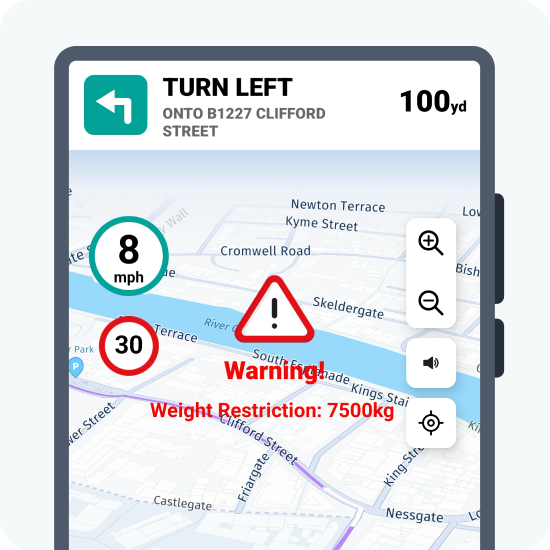
Complex lane guidance and speed limit indicators keep drivers informed and compliant, reducing the risk of fines and accidents.
When a width, for example, is specified, the routing engine will take into account legal restrictions. Beyond legal restrictions, our turn-by-turn routing system is optimised for commercial vehicles. Turn favours high-priority roads and will actively avoid unsuitable routes such as narrow residential streets, small forest roads, or tight, narrow side streets, even if a formal width limit isn’t posted.
Because Turn GPS connects to Stream’s ecosystem, drivers can launch turn-by-turn navigation directly from their delivery stops, reducing the time spent manually entering postcodes.
3. Use van and HGV specific mapping
Safe routing for vans and HGVs isn’t just about avoiding bridges.
It is also ensuring that drivers are routed safely and efficiently.
Not only does Turn ensure drivers avoid low bridges, but it can also ensure drivers don’t need to make unsafe turns or travel down unsuitable roads.
For Land Energy, a supplier of wood pellet fuels, this was particularly important:
“Turn means any of our drivers can jump in the cab and navigate to each delivery location safely. Personally, I’m based in the South West. We do have a lot of narrow roads down here in rural locations, which aren’t necessarily restricted for weight, for instance, but we know that they’re not suitable for a truck.”
If you have very specific routes you need your drivers to navigate, Turn also features ‘Waypoints’ and ‘Avoids’ to build custom routes to specific locations.
For Explore, a specialist haulage and plant hire business uses this particular feature for managing routes to construction sites and urban areas:
“Due to the type of contracts Explore has, we have to ensure drivers follow specific routes. For instance, they might not be able to pass through a certain village when travelling to a construction site. Even though that might not be the most direct route. If you put a location into Google Maps, it will bring up three different ways in which you can go. Turn will do that as well, but we can now build the precise route within the software. We know then that is the precise route the driver will take as well. And that is critical.”
Turn GPS uses a clean, familiar interface for drivers, offering clear, high-quality 2D and 3D map views that help drivers visualise complex junctions or turns before they arrive.
It also features a Night Mode (Dark Mode) to reduce glare and driver fatigue during late-shift deliveries, ensuring safety remains a priority 24/7.
4. Conduct thorough digital walkaround checks
Pre-journey checks are your first line of defence.
Using a digital walkaround check app ensures that height and width data are captured accurately and recorded before a driver sets off.
This creates a tamper-proof audit trail, proving due diligence was performed before the wheels started turning and any issues are identified through to resolution.
5. Obey signage!
While planning is vital, the driver must also remain aware, educated, and vigilant.
- Red circles vs. Red triangles: Understand that a red circle indicates a mandatory prohibition, whereas a triangle is a warning. Common examples include speed limits, “no entry”, no right/left turns, and no overtaking.
- Report discrepancies: If your measured height differs from what is shown on the vehicle’s headboard, report it to your transport manager immediately.
Safe & compliant routes for HGVs
Planning the perfect HGV delivery route is a combination of driver vigilance and smart technology.
By knowing your vehicle’s exact dimensions, using HGV-specific navigation tools like Turn GPS, and obeying road signs, you can protect your cargo, your licence, and the general public.
Don’t leave your route to chance. Plan ahead, stay height-aware, and keep the UK’s roads moving safely.
Explore how Turn GPS can protect your fleet.
Frequently Asked Questions
Unlike standard cars, Heavy Goods Vehicles (HGVs) face physical and legal restrictions including bridge heights, weight limits, and narrow road access. Using a dedicated HGV route planner helps drivers avoid over 1,500 annual bridge strikes in the UK and prevents costly fines, vehicle damage, and logistical delays.
Standard GPS apps like Google Maps and Waze are not designed for commercial vehicles and do not account for HGV dimensions. Relying on them increases the risk of being routed under low bridges or through weight-restricted zones. For professional fleets, a commercial-grade tool like Turn GPS is essential to ensure routes are physically possible for the specific vehicle profile.
According to Network Rail, the average cost of a single bridge strike is approximately £13,000. Annually, these incidents cost UK taxpayers around £23 million in repairs and structural inspections, not including the secondary costs of delivery delays and potential legal action against the operator’s licence (O-Licence).
Vehicle height can change depending on the trailer, load, and tyre pressure. Drivers should always measure their vehicle manually using a measuring pole or tape measure. By law, any vehicle over 3 metres must have its maximum travelling height clearly displayed in the cab. Using a digital walkaround check app can help record these dimensions accurately before setting off.
Turn GPS offers several safety and efficiency features specifically for trucks, including:
Vehicle-specific routing: Accounts for height, weight, width, and length.
Lane guidance: Clear visuals for complex junctions.
Speed limit indicators: Visual and audible alerts to keep drivers compliant.
Avoidance of unsuitable roads: Actively avoids narrow residential or forest roads even if no formal restriction is posted.
Night Mode: Reduces glare and fatigue during late-shift deliveries.