Now, more than ever, a successful omnichannel retail strategy is no longer just about maintaining a presence on multiple platforms; it is about intentional coordination and ensuring a seamless experience as customers loop between multiple digital channels and physical touchpoints.
According to the Online Retail Insights 2026 report by Linnworks and industry data on peak performance, retailers must pivot from siloed operations toward a true unified commerce model.
To construct their report, Linnworks surveyed 4,000 online shoppers in the UK and US to find out “how they browsed, compared, and made purchasing decisions in 2025”. The results show how shoppers have changed their buying habits and why that shift has occurred.
What’s clear from the report is how how people’s shopping becoming “increasingly dynamic, as they move easily between devices, channels and platforms, even within the same purchase. Buyers seek a more seamless journey, and appear less tolerant of small hurdles (such as slow page loading or unexpected shipping costs).”
Nothing is easy in retail, but what is clear is that success now depends on the strength (and depth) of your integrations.
Those retailers that ensure data flows effortlessly between marketing channels, e-commerce platforms, inventory, order and delivery management systems to eliminate silos within the operation, provide greater visibility and are able to cope with the high-pressure demands and fluctuations in a retail business.
Let’s now dig into some of the findings.
Establish a marketplace-first approach
For consumers, marketplaces have become the starting point for their shopping journey.
According to the study, 59% of all consumers begin their search on marketplace platforms such as Amazon or eBay.
However, taking a generic approach to marketplaces is no longer sufficient. Success requires tailoring your approach and presence to specific regional, demographic and product categories.
Regional nuances
While US shoppers rely heavily on large, one-stop-shop marketplaces (53%), UK shoppers typically show a significantly higher preference for direct retailer websites, with 25% starting their journey there.
Brands in the UK must balance marketplace reach with a strong brand destination on their own site.
Linnworks’ research shows that there is a relatively even split between UK and US shoppers on the categories they buy online (with the only significant difference being UK shoppers who buy 12% more books and entertainment online than US shoppers).
In the home goods category, where lots of our retail, wholesale and distribution customers operate, there is no discernible difference between UK and US shoppers with 34% and 35% respectively choosing to buy online.
A social shift
For younger demographics (ages 18–34), social media and speciality platforms are rapidly becoming primary discovery hubs.
Data published by Rithum, a global commerce solutions provider, showed that TikTok Shop was shifting perceptions in January 2026 and was a destination for higher-ticket items.
According to Rithum, “UK shoppers are increasingly comfortable purchasing premium goods via social commerce” [Source: Direct Commerce].
That data certainly mirrors the feedback we’re hearing from Stream subscribers who sell big and bulky items through TikTok Shop and then deliver those items with their in-house fleet.
Interestingly (and to prove the point that there’s never a dull moment and the landscape changes constantly), the latest research from the Retail Technology Show (RTS) showed that Roblox has overtaken TikTok as the fastest-growing Gen Z shopping channel.
Where those consumers will be buying their high-ticket items in the future, who knows!
Strategic integrations
To thrive during peak periods, presence on these marketplaces must be backed by robust integrations.
This ensures that pricing updates, product listings, inventory, fulfilment, promotional changes and logistics operations if you’re delivering using an in-house fleet are synchronised instantly across every platform, preventing the overselling, stockouts and failure to meet delivery expectations that can damage brand reputation (and lead to issues with marketplace account health issues).
Prioritise a mobile-first hybrid journey
Mobile devices have become the cornerstone of the shopper experience, shaping most browsing and everyday buying.
50% of consumers cite smartphones as their device of choice, according to LInnworks, with laptops/desktops coming in at 39.5% and tablets at 10%.
Experience continuity
It is critical to support cross-device shopping so that a customer can begin browsing on a smartphone during a commute and finish the transaction on a laptop later without losing their basket.
Frictionless checkout
Implementing mobile-friendly tools and a simple checkout process reduces hesitation and keeps customers moving through the funnel.
When we attended Linnworks’ Linn Academy event last year, Retail Economics was amongst the presenters during the day.
Their session suggested that an incredible £38.3 billion (yes, billion) was being lost at checkout due to basket abandonment (up 11% YoY).
24% of online purchases are abandoned at the final stage, said Retail Economics, due to unmet delivery expectations.
Lack of delivery options and high delivery costs result in almost half of consumers abandoning transactions (47%).
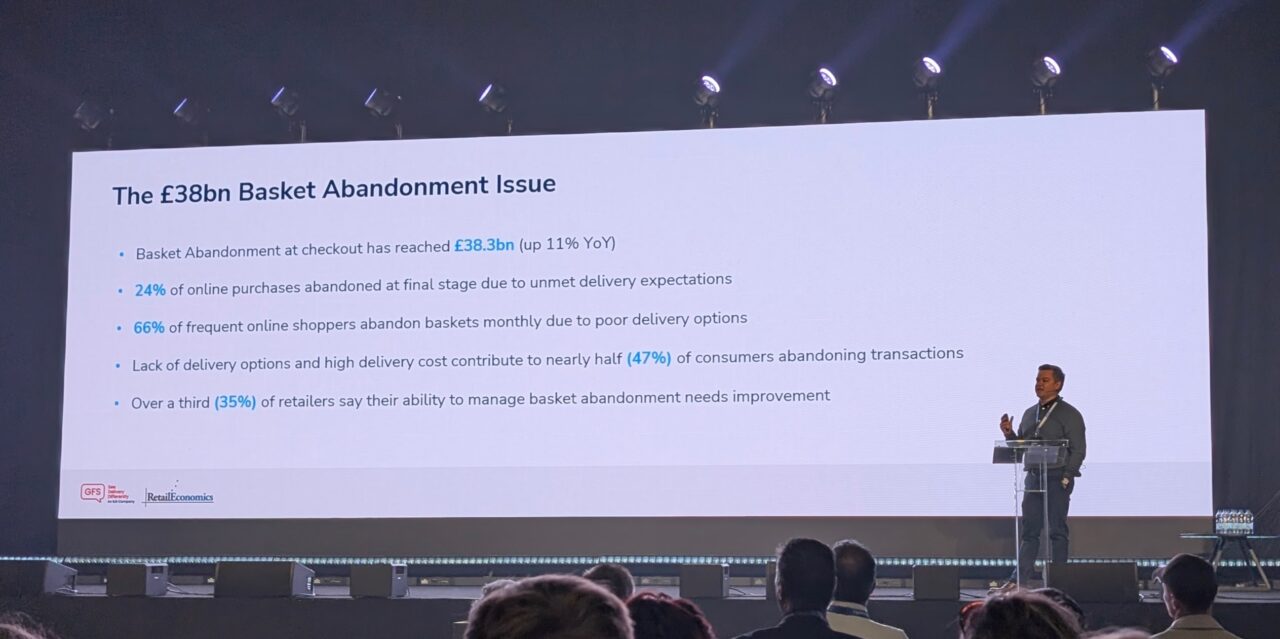
Taking those numbers into consideration, it’s worth noting that everything isn’t lost and that retailers can actually use delivery to their competitive advantage…
Transform delivery and fulfilment into a retention engine
Shipping clarity and speed have evolved from operational necessities into competitive advantages.
Ever since Stream was first designed, the platform has been developed not only to ensure that in-house delivery operations are as efficient as possible, but also with the customer in mind.
Real-time visibility
As discussed earlier, high shipping costs and out of stock messages are the primary drivers of cart abandonment.
By integrating your warehouse, inventory, order and delivery management systems with your marketplaces, you provide customers with accurate, real-time stock levels, reducing the risk of cancelled orders during high-traffic events.
Our subscribers can also benefit from integrations with Amazon, eBay and Temu to provide valid tracking for in-house deliveries.
Valid tracking enables sellers and 3PL providers to grow with confidence through marketplaces by helping to maintain account health and reduce ‘item not received’ (INR) claims with valid ePODs.
The positive return loop
Returns management is a primary lever for repeat business; 81% of shoppers rate free returns as vital.
Proactive communication
Using automated SMS and email notifications for tracking reassures customers, giving them fewer reasons to switch to a competitor.
Centralise operations for unified success
Managing the complexity of an omnichannel strategy requires moving away from fragmented systems and adopting a single operating system for ecommerce.
All-in-one inventory solutions like Linnworks allow brands to:
Unify and automate
Synchronise stock across all marketplaces in real-time. Automation minimises manual workloads, allowing your team to focus on strategy rather than data entry.
Scalability for peak season
Integrated systems are built to handle the sudden surges in order volume characteristic of Q4. They ensure your infrastructure doesn’t buckle under the pressure of increased API calls and transaction density.
Reduce errors
Use automation to eliminate mispicks and shipping delays. Since damaged or incorrect items are the most frustrating experience for shoppers, reliable fulfilment is essential for long-term retention.
Build trust through high-quality, transparent content
Shoppers in 2026 are highly discerning and will abandon a journey at the first sign of friction. Detailed, accurate product content is the most effective way to build early confidence.
The decision pillars
Consumers rely most heavily on clear descriptions (91%), high-quality images (88%), and precise sizing (81%).
The power of social proof
Reviews are critical for 76% of shoppers, rising to 82% for younger generations who value authentic feedback.
Centralised data
Using a single source of truth for your product data ensures that technical specifications remain consistent whether a customer encounters your brand on TikTok, Amazon, Temu, your own online store.
Adapt to the ‘hold-out’ economy and value sensitivity
Economic pressures have led to a ‘hold-out’ economy where consumers are less prone to impulse buys and more likely to wait strategically for final price drops.
Price and quality
Price remains the top decision factor for 69% of shoppers, but quality and delivery speed follow closely.
Agile pricing
During peak seasons, the ability to adjust prices in real-time based on competitor activity is vital.
Integrated systems allow you to deploy targeted incentives and loyalty rewards to specific groups, protecting margins while providing genuine value to price-sensitive UK shoppers.
“62% of UK respondents look for discounts, compared with 48% in the US.”
Conclusion
Retail success can hinge on delivering unified commerce, not just a multi-channel operation.
By centring your retail business on a mobile-first journey, high-quality content, deeply integrated marketplace systems and a superior delivery experience, you can turn market complexities into a lasting competitive advantage.